
THE WELSH CORGI PEMBROKE
HISTORY
A big dog in a small dog.

Less ancient than the Cardigan Welsh Corgi, the Pembroke has a less nebulous history although its origins are disputed. It is not known how and when this breed was introduced to the British Isles: some maintain that the Pembroke Corgi, which has similar features to the Västgötaspets (Swedish Vallhund), a Swedish breed of sheepdog, was imported by the Vikings. According to others, however, the origin of the Corgi is indigenous, since in Great Britain there is news in historical documents from the 10th century of a "curre" or "cur dog", a word which means working dog and whose sound is very similar to the Welsh pronunciation of the term Corgi. The area of origin and greatest diffusion of the breed remains Pembrokeshire in Wales, so much so that it arrived there by sea with Nordic navigators, as it is the result of the evolution of the subjects present in the region at the time of the first human settlements. The Welsh name for the Pembroke is "Ci Sodli", which means hock, to indicate the characteristic habit of biting the hocks of cows. On Welsh farms the Corgi acted as a sheepdog, guiding the herd to pasture, guarding it at night, and bringing back stray animals; during the transfer of the cattle to market he accompanied them along the route, ready to protect them from the many dangers that were common in the wild.
: Its appearance at that time was undoubtedly quite different from what we can see today. It varied in type and size and had rough hair, but it had the same temperament as today. The characteristic of biting the hocks was useful in driving cattle, but proved to be a serious mistake when applied to sheep. In 1880, the shepherds of Cardiganshire (now Ceredigion), to overcome this problem, thought of crossing the Corgi with the Welsh Collie, another herding breed used in Wales: from this cross it is believed that the Cardigan variety originated, which retains among its characteristics the blue merle coat common to all varieties of the Collie breed. The Corgi, despite its uncommon qualities and abilities, would have remained a farm dog if its destiny had not foreseen one day the meeting with a very special little girl. In 1933, the then Duke of York, later King George VI, bought a puppy of this breed, Rozavel Golden Eagle, to give to his daughter Elizabeth (later Queen Elizabeth II). The dog was renamed Dookie and immediately won the hearts of the royal family. This first subject was soon joined by many others, giving life to the royal family kennel known by the affix Windsor. Since then, Corgis have become by definition "the Queen's dogs", a definition that has entered current usage and is known by all, while the name 'Welsh Corgi Pembroke' is still little known in Italy.
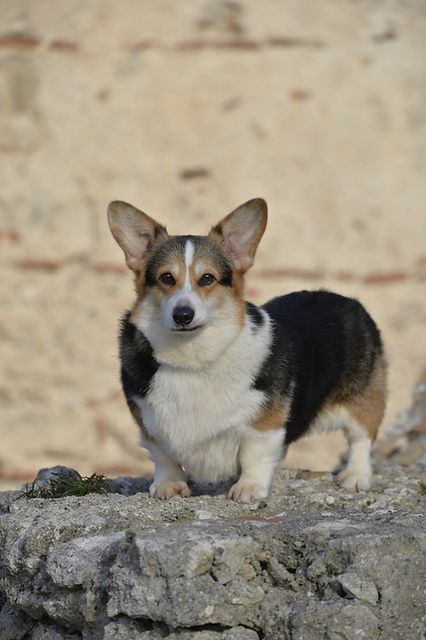

: Its appearance at that time was undoubtedly quite different from what we can see today. It varied in type and size and had rough hair, but it had the same temperament as today. The characteristic of biting the hocks was useful in driving cattle, but proved to be a serious mistake when applied to sheep. In 1880, the shepherds of Cardiganshire (now Ceredigion), to overcome this problem, thought of crossing the Corgi with the Welsh Collie, another herding breed used in Wales: from this cross it is believed that the Cardigan variety originated, which retains among its characteristics the blue merle coat common to all varieties of the Collie breed. The Corgi, despite its uncommon qualities and abilities, would have remained a farm dog if its destiny had not foreseen one day the meeting with a very special little girl. In 1933, the then Duke of York, later King George VI, bought a puppy of this breed, Rozavel Golden Eagle, to give to his daughter Elizabeth (later Queen Elizabeth II). The dog was renamed Dookie and immediately won the hearts of the royal family. This first subject was soon joined by many others, giving life to the royal family kennel known by the affix Windsor. Since then, Corgis have become by definition "the Queen's dogs", a definition that has entered current usage and is known by all, while the name 'Welsh Corgi Pembroke' is still little known in Italy.